
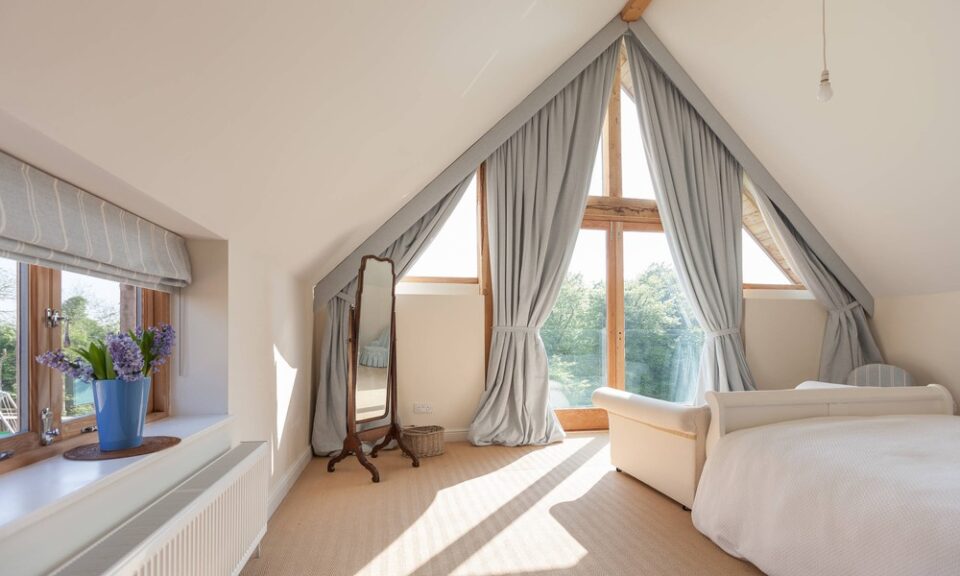
Not every window arrives blessed with perfect symmetry and soaring proportions.
Some are too narrow. Some sit awkwardly off-center on the wall. Some are frustratingly tiny, especially in older bedrooms where architecture prioritized function over aesthetics. And while beautifully proportioned windows tend to decorate themselves, awkward ones can make an entire room feel visually unsettled if handled poorly.
This is where good design becomes less about rules and more about illusion.
Designers rarely try to “fix” awkward windows by drawing attention to their flaws. Instead, they use curtains, shades, scale, and visual balance to reshape how the eye perceives the architecture altogether. A narrow window can suddenly feel grander. An off-center placement can begin to look intentional. Even a tiny bedroom window can feel soft, elegant, and atmospheric rather than apologetically small.
The secret is understanding that window treatments do far more than cover glass. They influence proportion, symmetry, light, and the emotional balance of a room.
And when handled thoughtfully, even difficult windows can become some of the most beautiful parts of a home.
Narrow Windows Need Width, Not Emphasis
Narrow windows are common in older homes, compact apartments, hallways, and certain bedroom layouts. On their own, they can feel visually pinched – especially when dressed too literally.
One of the biggest mistakes people make is matching the treatment too precisely to the actual width of the window. This only emphasizes how narrow the opening truly is.
Designers almost always do the opposite.
Extend Curtain Rods Beyond the Window
To make a narrow window appear larger, curtain rods are typically mounted significantly wider than the actual frame.
This creates the illusion that:
- The window extends farther across the wall
- More glass exists behind the curtains
- The room feels broader and more balanced
When the curtains are open, the fabric rests mostly beside the window rather than covering it. This allows maximum light into the room while visually expanding the architecture.
It is one of the oldest designer tricks for a reason: it works immediately.
Fullness Matters More Than Expensive Fabric
Skinny curtain panels on narrow windows often make the proportions feel even more awkward.
Designers usually use fuller panels with generous folds because softness and volume help balance narrow architecture. The eye focuses on the elegant custom curtains rather than the exact dimensions of the glass itself.
The goal is not to hide the window entirely. It is to create a broader visual frame around it.
Floor-to-Ceiling Curtains Add Importance
Small narrow windows often feel insignificant because they occupy so little wall space.
Floor-to-ceiling curtains solve this beautifully.
By extending fabric from near the ceiling all the way to the floor, designers create vertical drama that shifts attention away from the window’s limited width. The eye begins reading the entire curtain composition rather than the small opening at its centre.
This instantly makes the room feel taller and more refined.
Off-Center Windows Require Visual Balance
Off-center windows frustrate homeowners because they disrupt symmetry naturally. A bed may no longer align properly. Furniture placement begins to feel awkward. The entire room can feel slightly “wrong” without anyone immediately understanding why.
But designers rarely fight off-center windows directly.
Instead, they create balance around them.
Use Curtains to Re-Center the Composition
One of the simplest ways to soften an off-center window is by visually enlarging its footprint with drapery.
Curtains mounted wider than the window itself help create the illusion of a more balanced wall. Once the curtain panels extend beyond the frame, the eye begins reading the entire treatment as the architectural feature rather than the exact placement of the glass.
This works especially well in bedrooms where symmetry contributes heavily to a calming atmosphere.
For example:
- A slightly off-center bedroom window can feel centered once framed with wide drapery panels
- Matching bedside lamps and balanced furniture help reinforce visual stability
- The room begins to feel intentional rather than accidentally asymmetrical
Design is often about controlling where the eye rests.
Stop Trying to Force Perfect Symmetry
One of the biggest mistakes people make with off-center windows is overcorrecting.
Attempting to force rigid symmetry around architecture that naturally resists it can make the imbalance feel even more obvious. Instead, designers often embrace a softer form of balance.
This might mean:
- Using asymmetrical artwork intentionally
- Layering furniture organically
- Letting one side of the room breathe more openly
- Creating balance through colour and lighting instead of exact placement
Rooms feel more sophisticated when they acknowledge the architecture gracefully rather than fighting it aggressively.
Roman Shades Can Help Simplify Busy Walls
In some cases, especially where off-center windows sit near built-ins or awkward furniture layouts, custom roman shades can feel cleaner than curtains.
Because roman shades stay visually contained within the frame, they reduce additional visual movement across the wall. This can help the room feel calmer and more structured.
Soft linen roman shades are especially effective because they still add warmth without overwhelming the architecture.
Tiny Bedroom Windows Need Softness and Illusion
Tiny bedroom windows often make rooms feel darker and more enclosed than they actually are. But the problem is usually not the size alone. It is how the window is treated.
Many small windows become visually smaller because they are dressed minimally or ignored entirely.
Designers tend to approach them differently.
Make the Window Feel Larger Than It Is
Rather than emphasizing the exact dimensions of the glass, designers build a larger visual moment around it.
This often means:
- Hanging curtains significantly wider than the frame
- Mounting rods higher toward the ceiling
- Using longer curtain panels
- Creating softness around the opening
The eye begins focusing on the full vertical composition instead of the tiny window itself.
Suddenly, the room feels taller, softer, and more expansive.
Light Fabrics Prevent Small Rooms From Feeling Heavy
Tiny bedroom windows already limit natural light, so heavy opaque fabrics can sometimes make the room feel even more enclosed.
Designers often prefer:
- Linen blends
- Light-filtering curtains
- Relaxed roman shades
- Soft woven textures
These materials diffuse sunlight gently while maintaining brightness and softness throughout the room.
A small bedroom should feel intimate – not airless.
Layering Creates Depth
Layering window treatments can make even tiny windows feel more intentional and luxurious.
For example:
- Woven shades beneath linen curtains
- Roman shades paired with soft side panels
- Sheers layered under drapery
This added depth makes the architecture feel richer and more considered.
And interestingly, layered windows often distract from awkward proportions because the eye becomes focused on texture and atmosphere instead.
Stop Treating Awkward Windows Like Problems
One of the reasons awkward windows feel so difficult is because homeowners approach them defensively. They become something to apologize for rather than design around creatively.
But many beautiful homes contain imperfect architecture.
Old cottages have tiny windows. Historic apartments have strange placements. Character-filled homes rarely offer perfect symmetry in every room. And often, those quirks are exactly what make interiors feel soulful rather than generic.
Designers understand this instinctively.
Instead of obsessing over architectural imperfections, they focus on atmosphere:
- Softness
- Proportion
- Light
- Texture
- Balance
Once those elements are handled well, the window itself matters far less.
Final Thoughts
Awkward windows are not design failures. They are simply design challenges that require a little more creativity.
A narrow window can feel grand with properly scaled curtains. An off-center window can feel balanced through thoughtful composition. A tiny bedroom window can become soft and atmospheric instead of visually apologetic.
And ultimately, the most beautiful interiors are rarely the most technically perfect ones.
They are the ones that know how to work gracefully with the architecture they have – shaping light, softness, and proportion in ways that make the room feel warm, intentional, and beautifully lived in.
