
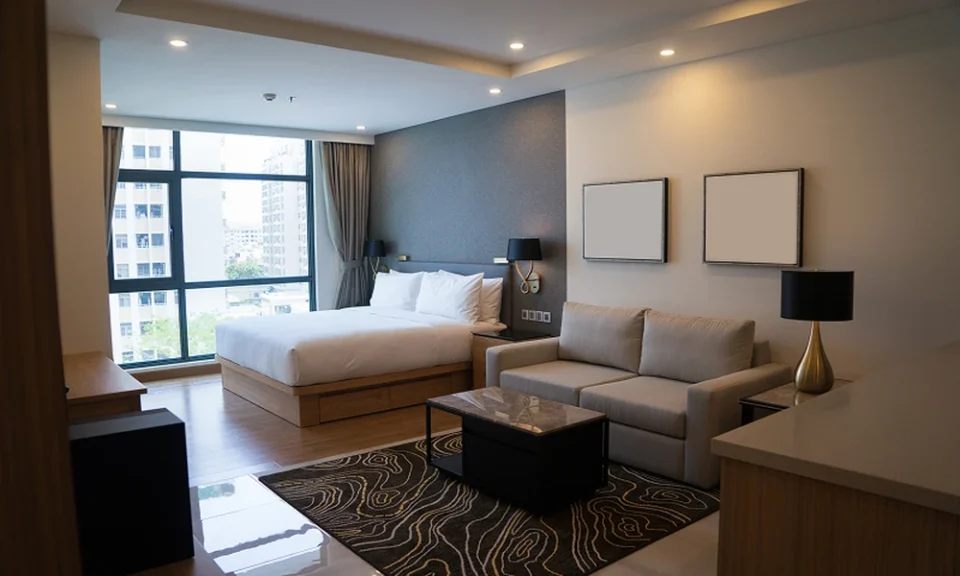
If a company has ever relocated several new hires in the same month, each needing a flat ready to move into on day one, the brief that follows looks nothing like furnishing a single household. Multiply one person’s furniture decisions by six, add a fixed move-in date for every unit, and the whole exercise turns into logistics first and furniture second.
What Changes When It’s Six Units, Not One
A company handling furnishing corporate housing at scale isn’t picking out pieces one room at a time. It’s coordinating the same move across multiple addresses, often on a single shared timeline, where every unit needs to be ready regardless of how many employees are actually relocating that month. The furniture decisions matter less here than the scheduling does.
Does every unit get furnished exactly the same way?
Usually, yes, within reason. A standardised set of pieces per unit type keeps quoting, delivery, and maintenance simple, though small adjustments for unit size or an employee’s specific needs are generally still possible.
How does delivery actually get handled across several addresses?
It’s typically coordinated as a single project rather than several separate orders, with delivery windows scheduled back-to-back so each unit is ready by the same target date rather than trickling in over weeks.
What happens when one employee moves out and another moves in?
The furniture generally stays in place between tenants, with a quick condition check and any needed refresh handled before the next occupant arrives, rather than furnishing the unit from scratch each time.
Consistency Matters More Than Character Here
- A standardised layout makes it easier to budget per unit rather than per employee’s taste.
- Maintenance and replacement are simpler to manage when every unit starts from the same baseline.
- New hires settle in faster when the flat is fully functional from day one, not mid-assembly.
That’s also where a straightforward furniture rental arrangement tends to outperform a purchase-based approach for corporate housing specifically. Buying furniture for six units ties up capital in assets a company has to track, maintain, and eventually dispose of, while a rental arrangement keeps all of that off the books.
Turnover Is the Part Nobody Plans For
Corporate housing rarely sits with the same occupant for years. Someone’s assignment ends, a new hire arrives, and the unit needs to be ready again within days, not weeks. Planning for that turnover upfront, rather than treating each handover as a one-off scramble, is usually what separates a smooth corporate housing programme from one that’s constantly playing catch-up.
Who Actually Owns This Inside the Company
In a lot of organisations, furnishing corporate housing lands somewhere between HR and facilities without clearly belonging to either. HR knows the headcount and the move-in dates, facilities knows the buildings and the practical constraints, and neither side necessarily owns the vendor relationship. Naming one person as the point of contact for the whole programme, even informally, tends to prevent the kind of back-and-forth that slows a multi-unit setup down.
What a First Rollout Usually Gets Wrong
Companies furnishing corporate housing for the first time often underestimate how much lead time the first batch of units actually needs, even when every unit afterward moves faster once a standard setup exists. Building in extra buffer for that first rollout, rather than assuming it’ll move at the same pace as a steady-state programme already running for a year, avoids a lot of last-minute pressure on the move-in date itself.
Budgeting Per Unit Instead of Per Employee
Once a standard setup exists, the cost of furnishing becomes a known, repeatable figure rather than something that has to be re-estimated for every new hire. That predictability tends to matter more to finance teams than the specific furniture choices do, since it turns a variable relocation cost into something that can actually be planned for in advance rather than approved case by case.
None of this requires a facilities team to become furniture experts. It mostly requires picking a setup built to be repeated across units, rather than reinventing the brief every time someone new needs a place to live.
Send over the unit count and the timeline, and a quote can usually be put together around both. Contact WTP to get the specifics sorted.
