
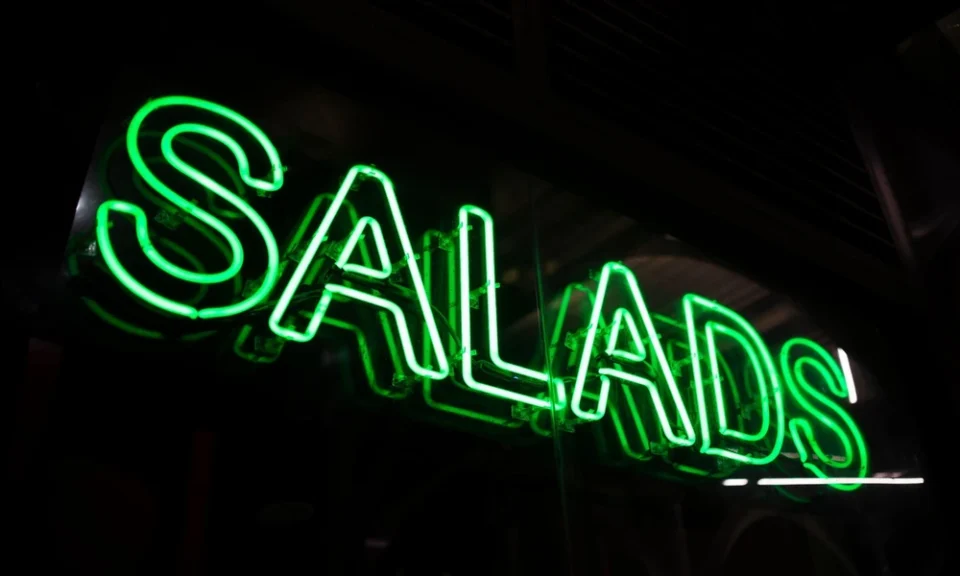
The word ‘neon’ still does a lot of work in how these signs get sold and searched for, but it describes almost none of what’s actually being made today. A genuine neon sign is a glass tube filled with an inert gas, running on several thousand volts, fragile enough that a technician has to install and service it. Almost every custom sign sold under that name now is something else entirely: a flexible strip of LED-lit silicone or PVC that only looks like gas-filled glass from a few feet away.
Flame-Resistant Plastic and Low-Voltage Wiring Replaced the Glass Tube
What’s sold today as custom neon signs is almost always LED neon flex: a run of small LEDs sealed inside a flexible, flame-resistant tube that bends into letters and shapes the way a glass tube never could without cracking. It runs on 24 volts or so rather than the 3,000 to 18,000 volts a genuine glass neon tube needs, and it contains no mercury or inert gas at all. That difference in voltage alone is why an LED neon piece can be handed over and plugged in directly, while a glass neon installation generally calls for a qualified electrician.
None of this makes LED neon a lesser substitute. It’s closer to a different product that happened to borrow neon’s look and its name, built specifically to solve the fragility and installation hassle that glass neon never really got around.
Does Switching Away From Glass Mean a Dimmer or Flatter Glow?
Not noticeably, for most custom sign uses. LED neon flex diffuses light along its length as a continuous glowing line rather than a row of individual points, which is the whole point of the flexible tubing around it. Where it differs is in how tightly it can curve: very small lettering with sharp inner corners can look slightly different from how the same design renders in hand-blown glass, since the flex has its own minimum bend radius. For most logos and shop signage, that difference isn’t something a viewer would notice without comparing the two side by side.
A Sign Maker’s Experience With LED Neon Shows Up in the Wiring, Not Just the Glow
This is also where choosing the right sign maker actually matters, even though LED neon looks like a simpler product on the surface. A well-built piece uses a proper low-voltage driver matched to the sign’s length, routes wiring so it doesn’t show through a mounting surface, and rates the piece for indoor or outdoor use correctly rather than treating every job the same way. Those details rarely show up in a quick glance at a finished sign, but they’re exactly what separates a piece that holds up for years from one that starts flickering or dimming unevenly within months.
A Few Things Worth Asking Before Committing to a Design
- Whether the sign is rated for outdoor exposure if it’s going anywhere near a window, storefront, or uncovered wall, since indoor-only LED neon can degrade faster outside.
- Whether a damaged section can be repaired or swapped on its own, rather than requiring the entire sign to be remade from scratch.
- Whether the driver is dimmable, which matters for anyone planning to run the sign at lower brightness during the day or late at night.
Is LED Neon Actually Cheaper, or Just Cheaper to Buy?
Both, generally. Glass neon tubing averages roughly 10,000 hours of use before it needs replacing, while LED neon can run for up to around 50,000 hours under normal conditions, which works out to several extra years of use in practical terms. Add in lower running power and far less need for servicing, and the lower upfront price isn’t the only place LED neon comes out ahead. It just rarely gets credited for that, since the comparison usually stops at which one costs less to order on day one rather than what either option costs to keep running for the next five years.
Knowing which product is actually being ordered, and what a sign maker does differently to build it well, matters more than the name printed on the listing or the quote.
Sui Generis Neon can talk through sizing, mounting, and indoor-or-outdoor ratings for a custom piece before anything is fabricated. Contact Sui Generis Neon to start the conversation.
